
The History of American Traditional Tattoos
Share
The History of American Traditional Tattoos
Bold lines. Solid color. An eagle, a rose, or a crawling panther you can recognize from across the room.
American traditional tattoos have a look that has held its own through generations of tattooing. The designs are direct, but the history behind them covers a lot of ground: New York’s Bowery, military ports, Honolulu, and the tattoo shops of Southern California.
Sailor Jerry is part of that story. So are the artists who came before him, worked alongside him, and carried the work into their own shops. American tradition took shape over decades, with artists trading designs, building equipment, and tattooing whoever walked through the door.
What Makes a Tattoo American Traditional?
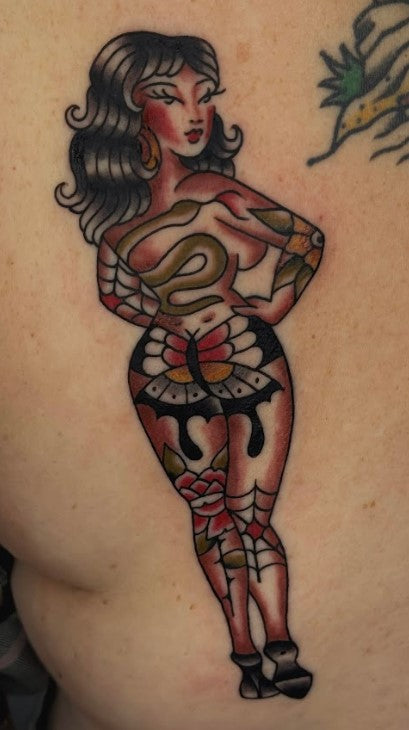
American traditional, also called old school, is built around strong black outlines, deliberate shading, and a clear design. Red, yellow, green, and black are familiar colors, although traditional tattoos also work in black and gray.
The subjects are recognizable: eagles, roses, hearts, skulls, daggers, snakes, ships, and pin-ups. Each gives an artist plenty to work with without losing the straightforward composition that defines the style.
A traditional panther gets its power from its shape, movement, claws, and heavy black shading. A rose relies on the arrangement of its petals and leaves. Every part has a job.
That leaves room for individual style. Put the same subject in front of several traditional tattooers and you will get different drawings, even when they share the same foundations.
Before American Traditional
Tattooing was already thousands of years old before American traditional developed. Indigenous peoples throughout the Americas and the Pacific had established tattoo practices with their own cultural meanings and histories.
Those traditions deserve to be understood on their own terms. They are part of the wider history of tattooing, but they should not all be folded into the origin story of one Western style.
Maritime travel helped spread tattooing among European and American sailors. Voyages brought sailors into contact with tattoo practices overseas, and they returned wearing reminders of their travels. The English word “tattoo” comes from the Polynesian word “tatau.”
Ships, anchors, names, and other familiar images became part of sailors’ lives. Tattoos could record an experience, express loyalty, remember someone at home, or carry a protective meaning.
Electric Tattooing and the Bowery
On December 8, 1891, New York tattoo artist Samuel O’Reilly received U.S. Patent No. 464,801 for an electric tattoo machine.
His design drew on technology associated with Thomas Edison’s electric pen, a device developed for copying documents. Electric tattooing had been explored before O’Reilly received his patent, so the date marks a documented milestone rather than the first time electricity touched the trade.
New York’s Bowery and Chatham Square became important places in the development of professional American tattooing. Charlie Wagner worked there from the 1890s and later occupied O’Reilly’s former shop at 11 Chatham Square. Wagner also received a tattoo-machine patent in 1904.
The trade was developing through both the equipment artists used and the designs they put on skin.
Flash Helped Build the Style
Walk into a tattoo shop and look at the designs on the walls. That experience has a long history.
Flash sheets gave customers designs to choose from and showed what an artist could do. They also gave tattooers a way to exchange ideas.
Lew Alberts, born Albert Morton Kurzman, was an influential early twentieth-century tattooer associated with New York’s Bowery. The Contemporary Jewish Museum identifies him as one of the early developers of flash. His surviving drawings and correspondence show artists across the country influencing one another’s work.
Printed designs and mail-order businesses helped those images travel. Artists including Alberts and Percy Waters helped circulate the flash beyond a single shop or city.
The familiar subjects became a shared starting point. Each artist could redraw them, change the composition, and bring their own hand to the work.
Sailors, Soldiers, and World War II
Military life helped carry tattooing between ports and across the country.
During World War II, servicemen often got tattooed before heading overseas. Patriotic designs, military imagery, names, and reminders of home expressed what mattered to someone facing an uncertain future.
The tattoos came home with the people who wore them. As a teenager, future tattoo artist Lyle Tuttle became interested in the work after seeing tattoos on returning servicemen.
Surviving flash from the period includes designs by Bert Grimm, Owen Jensen, Sailor Jerry, Milton Zeis, and others. It is a record of the range of artists working during an important period in American tattoo history.
Where Sailor Jerry Fits In
Norman “Sailor Jerry” Collins settled in Hawaii in the 1930s and worked at several locations in Honolulu.
His ships, eagles, pin-ups, and other designs became some of the best-known examples of American traditional tattooing. His work also incorporated Japanese influences, bringing different approaches to drawing and composition into the tattoos he made.
Collins exchanged designs with other tattooers, including mailing impressions of new designs to friends. That exchange was part of how artists learned from one another and kept developing their work.
He helped shape the style people recognize today, building on a trade that was already well underway.
The Long Beach Pike and Southern California
Southern California has its own place in this history.
The Pike in Long Beach was a waterfront amusement district with arcades, attractions, sailors, visitors, and tattoo shops. For generations of tattooers, it became a place to work, learn, and build a reputation.
Bert Grimm purchased the shop at 22 Chestnut Place in 1954. Bob Shaw, who had learned to tattoo from Grimm, moved to Long Beach to work with him in 1964 and bought the shop in 1969.
The connection reaches into Orange County, too. In 1973, Shaw and fellow tattooer Col. Todd opened a Santa Ana shop where Bobby Shaw and Bob Roberts could learn to tattoo.
These were working shops where knowledge passed from one artist to another. The history of traditional tattooing in Southern California lives in those relationships as much as in the designs.
Why People Still Choose American Traditional
The appeal starts with the artwork. Strong shapes, solid black, and clear compositions give traditional tattoos their presence.
Familiar subjects also leave room for personal meaning. A heart might carry someone’s name. A ship might mark a change in your life. Or you might want a ship because you like the way your artist draws ships.
There is no requirement to attach a dramatic story to a tattoo. You can appreciate the history, respect the work, and choose something you want to wear.
Traditional gives artists and clients a lot to build on, whether that means one piece or a collection put together over years.
American Traditional Tattoos at American Vintage Tattoo
At American Vintage Tattoo in Orange, California, American tradition is part of the work we do.
Bring us your references, a subject you have been thinking about, or a few ideas you want to talk through. Our artists can help work out the drawing, size, and placement.
Take a look at our American traditional tattoo gallery, then book an appointment. Let’s get your next tattoo started.